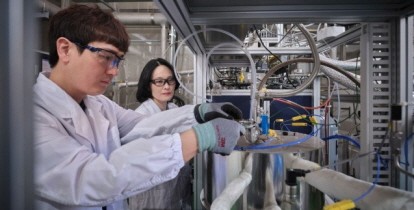
DAEJEON, SOUTH KOREA -- The Korea Institute of Energy Research (KIER, President Yi Chang-Keun) announced that its research team led by Dr. Koo Kee-Young of the Hydrogen Research Department has developed a high-performance copper-magnesium-iron catalyst that efficiently converts carbon dioxide (CO₂)—a major greenhouse gas—into carbon monoxide (CO), a key building block for eco-friendly synthetic fuels.
The breakthrough targets the reverse water-gas shift (RWGS) reaction, which converts CO₂ and hydrogen (H₂) into CO and water (H₂O). The resulting CO can be combined with hydrogen to produce syngas, the foundation for synthetic fuels such as e-fuels and methanol.
Traditional nickel-based catalysts offer excellent thermal stability, but require reaction temperatures exceeding 800 °C. Prolonged operation at such high temperatures causes particle agglomeration, leading to loss of activity. At lower temperatures, methane byproducts are generated, lowering CO selectivity.
To address these challenges, the KIER team developed a cost-effective copper-based mixed oxide catalyst that demonstrates high CO productivity even at 400 °C. The new catalyst achieved a 1.7-fold higher CO formation rate and a 1.5-fold higher yield than commercial copper catalysts.
Copper catalysts can selectively produce CO without forming methane below 400 °C, but often suffer from poor thermal stability. KIER’s innovation uses a layered double hydroxide (LDH)-derived structure incorporating iron and magnesium, which fills the gaps between copper particles, prevents agglomeration, strengthens Cu-FeOx interactions, and significantly enhances durability.
Spectroscopic analyses confirmed that the new catalyst directly converts CO₂ into CO on its surface—bypassing formate intermediates common in conventional copper catalysts. It achieved a CO yield of 33.4% and a formation rate of 223.7 μmol·gcat⁻¹·s⁻¹, maintaining stable performance for over 100 hours.
Dr. Koo stated, “This low-temperature CO₂ hydrogenation catalyst enables the efficient and economical carbon monoxide production using abundant metals, paving the way toward industrial-scale sustainable fuel synthesis and carbon-neutral energy systems.”
The research was published online in May 2025 in Applied Catalysis B: Environmental and Energy (Impact Factor 21.1) and supported by KIER’s R&D project on e-SAF (sustainable aviation fuel) production from CO₂ and H₂.